
After hiragana and katakana, start grammar, everyday vocabulary, and beginner kanji together, while practicing listening and simple speaking from day one. You don’t need to “finish” kanji before grammar — the fastest progress comes from building all three side by side, ideally inside a structured beginner course.
Learning kana is a real milestone. But it often leads to a new question: “I can read the characters now — what do I actually learn next?”
Here’s the practical order to follow, and how it’s built into the Nihon Path Japanese course for beginners.
What Should You Learn After Hiragana and Katakana?
Focus on six things, together — not one at a time:
- Basic grammar
- Everyday vocabulary
- Beginner kanji
- Listening and pronunciation
- Simple speaking
- Reading beginner Japanese
1. Start Basic Grammar Early
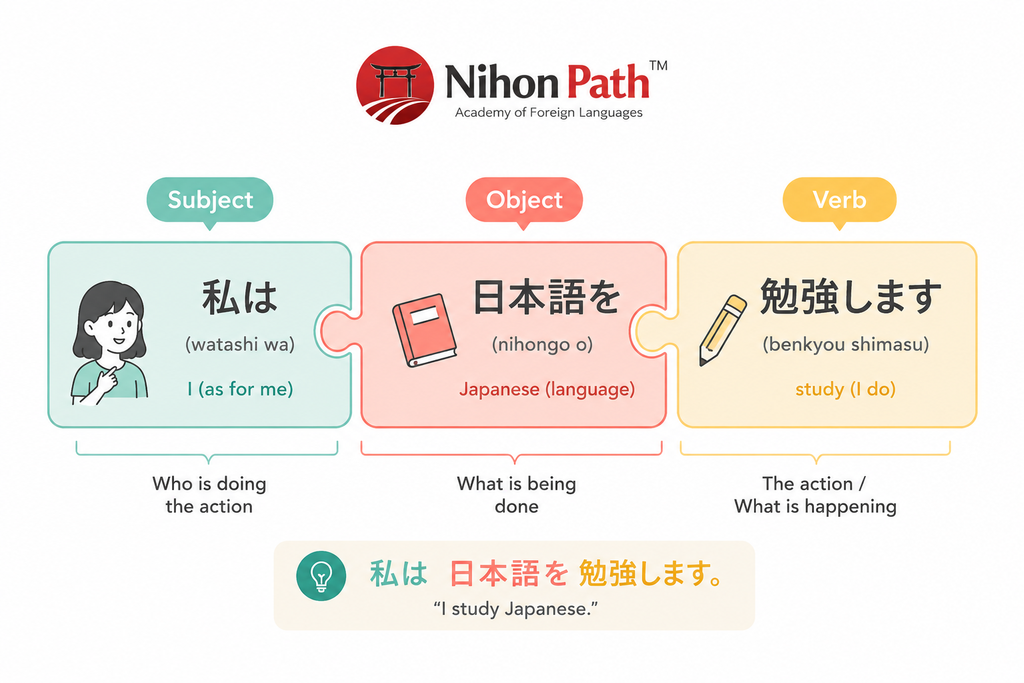
Once you can read kana, grammar should become one of your main priorities.
Hiragana and katakana tell you how Japanese is written, but grammar teaches you how Japanese sentences work.
Start with simple structures such as:
- X is Y
- X is not Y
- This/that
- Possession
- Basic questions
- Present and past tense
- Basic adjectives
- Basic verbs
- Particles
- Simple requests
- Location and existence
For example:
これは本です。
Kore wa hon desu.
This is a book.
Then gradually move toward sentences such as:
私は日本語を勉強します。
Watashi wa nihongo o benkyou shimasu.
I study Japanese.
The goal isn’t to memorize isolated grammar rules. It is to understand how grammar helps you create your own sentences.
Why grammar should come early
Beginners sometimes think:
“I should learn 1,000 words first, then grammar.”
That can make learning unnecessarily difficult.
If you know the words:
私 — I
日本語 — Japanese
勉強 — study
you still need grammar to turn them into a meaningful sentence.
That’s why vocabulary and grammar should develop together.
2. Build Everyday Vocabulary in Context
After kana, start building a practical vocabulary rather than memorizing random Japanese words.
Focus first on words that you are likely to encounter repeatedly.
Useful beginner categories
People
- 私 — わたし — I
- 先生 — せんせい — teacher
- 学生 — がくせい — student
- 友達 — ともだち — friend
Daily activities
- 食べる — たべる — to eat
- 飲む — のむ — to drink
- 行く — いく — to go
- 見る — みる — to see/watch
- 聞く — きく — to listen/ask
- 話す — はなす — to speak
Places
- 学校 — がっこう — school
- 駅 — えき — station
- 店 — みせ — shop
- 家 — いえ — house
Rather than memorizing vocabulary as isolated translations, learn words inside simple sentences.
For example, don’t only memorize:
食べる = to eat
Also learn:
ご飯を食べます。
I eat a meal.
This gives you vocabulary, grammar and sentence structure at the same time.
3. Add Beginner Kanji — Gradually
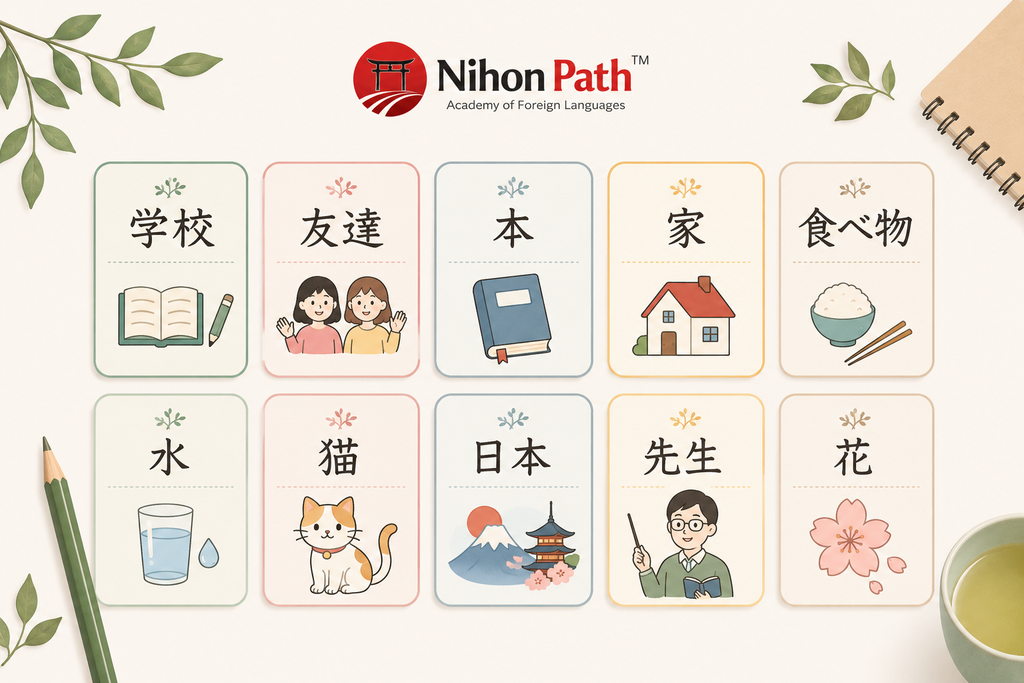
You don’t need hundreds of kanji right away. Start with high-frequency ones learned through vocabulary, not in isolation:
| Kanji | Meaning | Example |
|---|---|---|
| 日 | day/sun | 日本 |
| 月 | month/moon | 月曜日 |
| 人 | person | 日本人 |
| 大 | big | 大きい |
| 小 | small | 小さい |
| 学 | study | 学生 |
| 校 | school | 学校 |
| 水 | water | 水曜日 |
The important part is to learn kanji through vocabulary and context.
For example, learning: Learning 学生 (student) and 学校 (school) teaches you far more than memorizing 学 (study) alone.
4. Reduce Your Romaji Dependence
Once kana feels comfortable, shift from watashi wa gakusei desu to reading 私は学生です。 directly. You don’t need to drop romaji overnight — just make Japanese script your default.
5. Train Your Ears From the Start
Listen to beginner dialogues, slow conversations, and short podcasts. You won’t understand everything at first — that’s normal. You’re training your brain to recognize sounds, rhythm, and word boundaries before full comprehension follows.
6. Speak From Day One
You don’t need hundreds of kanji to start speaking:
こんにちは。私は日本語を勉強しています。日本が好きです。 Hello. I’m studying Japanese. I like Japan.
Repeating sentences aloud, introducing yourself, and practicing with a teacher — even briefly — builds confidence faster than silent study.
7. Start Reading Simple Japanese
Don’t jump into novels. Start with graded readers, beginner dialogues, and sentences with furigana. The goal is comprehension, not speed.
What About Anime?
If anime is one of your reasons for learning Japanese, you absolutely can use it as part of your learning.
But don’t make anime your only Japanese study method.
Anime can expose you to:
- Natural-sounding expressions
- Vocabulary
- Pronunciation
- Listening
- Japanese culture
- Different speech styles
However, some anime uses exaggerated, character-specific or highly informal language that beginners shouldn’t automatically copy.
A better approach is:
structured study + listening practice + anime for additional exposure.
That gives you both the foundation and the motivation.
A Simple Daily Routine
- 15 min — Vocabulary (new + review)
- 20 min — Grammar (one concept + practice sentences)
- 15 min — Kanji (through vocabulary)
- 10–15 min — Listening
- 5–10 min — Speaking
Common Mistakes to Avoid
- Trying to memorize all kanji immediately
- Studying vocabulary without context or sentences
- Staying dependent on romaji too long
- Waiting until “advanced” to start speaking
- Juggling five apps instead of one structured system
What Comes After Hiragana and Katakana?
Not sure where to start after Hiragana & Katakana?
Talk to Nihon Path on WhatsApp — get free guidance on grammar, kanji, and the right course level for you.
Chat with us on WhatsApp+91 93116 88893 • 5,000+ students • 100% online
Learning hiragana and katakana is the beginning of Japanese reading, not the end of Japanese learning basics.
Once you know both scripts, move into grammar, vocabulary and beginner kanji together, while developing listening, speaking and reading skills alongside them.
You don’t need to wait until your kanji is perfect before studying grammar. You don’t need to memorize thousands of words before speaking. And you don’t need to master every aspect of Japanese before starting to use it.
The best next step is to create a structured learning routine that gradually turns the characters you have learned into actual Japanese communication.
If your ultimate goal is JLPT N5, N4, N3 or eventually using Japanese for study or work, build your learning plan around that goal from the beginning.
Should You Take a Structured Course After Kana?
Self-study can work, but this is exactly the stage where most learners get stuck — too many resources, no clear sequence. A structured course solves this by giving you a defined path: grammar progression, vocabulary building, kanji practice, listening, and speaking practice with real feedback, all paced toward a goal like JLPT N5.
At Nihon Path, our Japanese language courses are built around exactly this progression — small batch sizes, 100% online, and trusted by 5,000+ students across India. If you’ve just finished hiragana and katakana and want a clear next step instead of guessing, this is where to start.
Have questions about what level to join? Chat with us on WhatsApp — +91 93116 88893.
Key Takeaways
- After hiragana and katakana, build grammar, vocabulary, and beginner kanji together
- Learn words inside sentences, not as isolated translations
- Reduce romaji dependence as kana becomes comfortable
- Start listening and speaking early — don’t wait
- A structured course removes the guesswork, especially heading toward JLPT N5
FAQs
What should I learn after hiragana and katakana?
Basic grammar and everyday vocabulary together, with beginner kanji introduced gradually — while starting to listen to and speak simple Japanese.
Should I learn kanji or grammar first?
Neither exclusively. Start grammar and vocabulary together, and add kanji through the words and sentences you’re already learning.
How many kanji should I learn at this stage?
There’s no fixed number. Start with common beginner kanji learned through vocabulary rather than memorizing a long list upfront.
Should I stop using romaji after learning kana?
Gradually, yes. Once you’re comfortable reading hiragana and katakana, reading Japanese script directly builds stronger fluency.
Can I self-study after hiragana and katakana?
Yes, but a structured course makes the transition easier by giving you a clear sequence and feedback — especially useful once resources start feeling overwhelming.
Should I prepare for JLPT N5 next?
If JLPT is your goal, N5 is a natural first milestone. Structure your grammar, vocabulary, kanji, reading, and listening study around it.