
The most essential Korean greetings every beginner needs are Annyeonghaseyo (hello, formal), Gamsahamnida (thank you, formal), Joesonghamnida (I’m sorry, formal), and Annyeong (hi/bye, casual). Learning these four phrases, along with basic polite expressions like Juseyo (please give me) and Sillyehamnida (excuse me), is enough to hold a simple, respectful conversation with a native Korean speaker — even before you start formal TOPIK preparation.
This guide breaks down 25+ practical Korean phrases by situation (greetings, politeness, restaurants, travel, daily life), explains the cultural logic behind Korean speech levels, and shows you exactly how to practice them so they stick.
Why Korean Greetings Matter More Than You’d Think
In most of India, a warm “Namaste” instantly signals respect. Korea works the same way — except the level of formality changes depending on age, social rank, and how well you know the other person. Get the greeting right, and Korean speakers immediately read you as someone who has taken the time to learn their culture, not just their vocabulary.
This matters whether you’re:
- Preparing for a trip to Korea
- Working with Korean clients or a Korean company
- Starting TOPIK I preparation
- Simply exploring K-dramas, K-pop, and Korean as a new language
Formal vs. Casual Greetings (The First Thing to Memorize)
| Korean | Romanization | Meaning | When to Use |
|---|---|---|---|
| 안녕하세요 | Annyeonghaseyo | Hello (polite, standard) | Strangers, elders, most everyday situations |
| 안녕히 계세요 | Annyeonghi gyeseyo | Goodbye (said to the person staying) | Leaving while the other person stays behind |
| 안녕히 가세요 | Annyeonghi gaseyo | Goodbye (said to the person leaving) | You’re staying, they’re leaving |
| 안녕 | Annyeong | Hi / Bye (casual) | Close friends, people younger than you |
| 처음 뵙겠습니다 | Cheoeum boepgesseumnida | Nice to meet you (very formal) | First-time formal introductions, business |
Tip: Annyeonghaseyo is the safest all-purpose greeting if you only remember one phrase — it works for both “hello” and, with the right context, doubles as a general goodbye in casual speech, much like “Namaste” does across regions in India.
Polite Expressions That Make You Sound Fluent
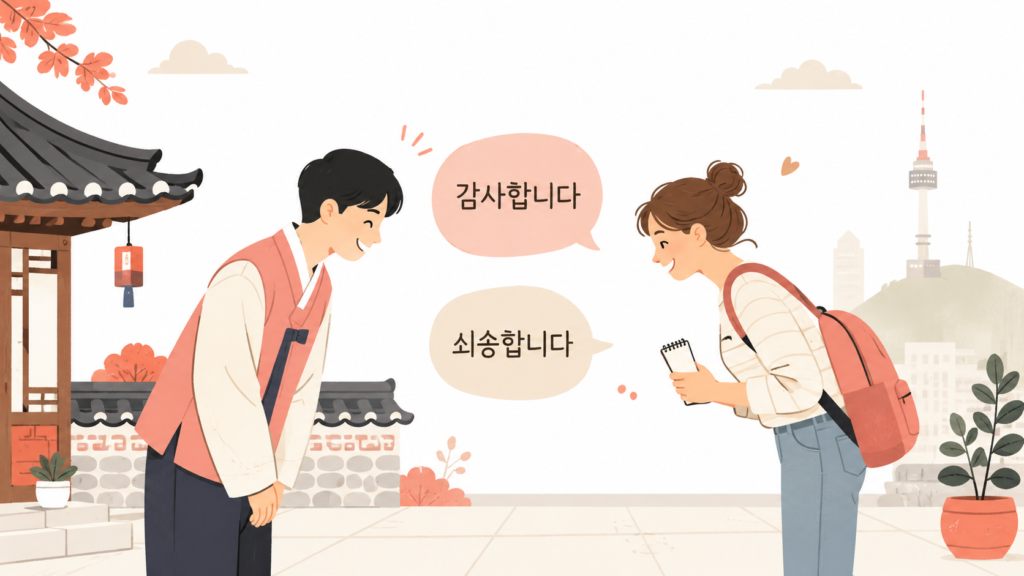
Korean conversation runs on speech levels and politeness markers. These small words and endings carry a lot of social weight:
- 감사합니다 (Gamsahamnida) — Thank you (formal). Softens to “고마워요 (Gomawoyo)” with people you know, and “고마워 (Gomawo)” with close friends.
- 죄송합니다 (Joesonghamnida) — A more formal, sincere “I’m sorry,” used for real apologies or in professional settings.
- 미안해요 (Mianhaeyo) — A softer, everyday “sorry,” used with peers and casual acquaintances.
- 주세요 (Juseyo) — “Please give me,” attached after a noun when requesting something, e.g., “물 주세요” (water, please).
- 괜찮아요 (Gwaenchanhayo) — “It’s okay / I’m fine,” used to reassure someone or decline politely.
- 실례합니다 (Sillyehamnida) — “Excuse me,” used to get attention or interrupt politely.
- 대박 (Daebak) — “Awesome!” or “No way!” — a reaction word Korean speakers use constantly in casual settings.
- 축하합니다 (Chukhahamnida) — “Congratulations.”
- 화이팅 (Hwaiting) — “Fighting!” — Korea’s go to phrase for cheering someone on before an exam, interview, or challenge.
Restaurant and Food Phrases
Korea’s food culture has its own mini-vocabulary that’s worth learning before your first trip or first Korean BBQ night:
- 맛있어요 (Masisseoyo) — Delicious.
- 잘 먹겠습니다 (Jal meokgesseumnida) — Said before eating, roughly “I will eat well.”
- 잘 먹었습니다 (Jal meogeosseumnida) — Said after finishing a meal, thanking for the food.
- 뭐가 맛있어요? (Mwoga masisseoyo?) — “What’s good here?” — useful when the menu is entirely in Korean.
- 물 주세요 (Mul juseyo) — “Water, please.”
Survival Phrases for Travelers
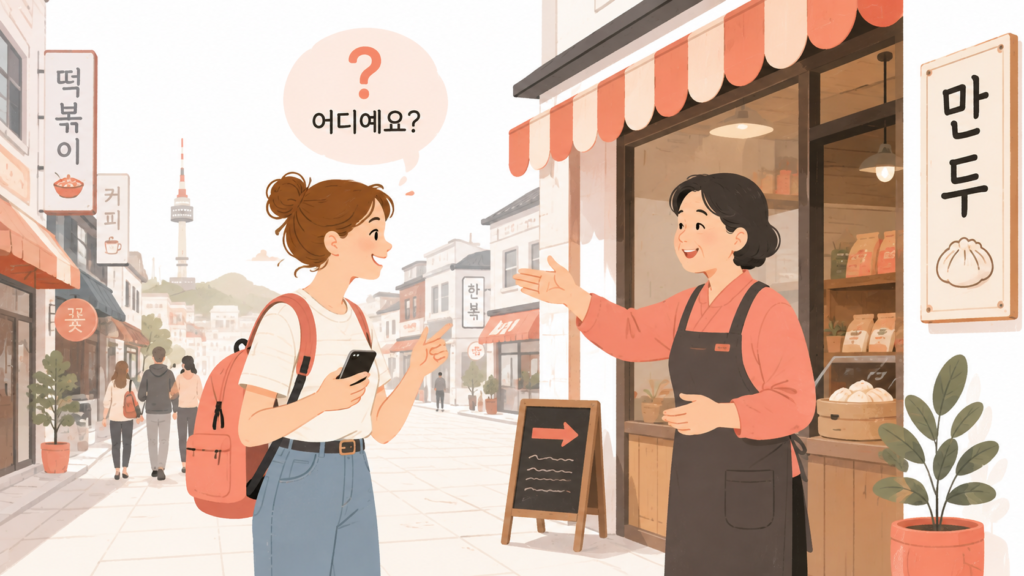
- 영어 할 수 있어요? (Yeongeo hal su isseoyo?) — “Can you speak English?”
- 어디예요? (Eodiyeyo?) — “Where is it?” — pair with a place name, e.g., “화장실이 어디예요?” (where is the bathroom).
- 얼마예요? (Eolmayeyo?) — “How much is this?”
- 모르겠어요 (Moreugesseoyo) — “I don’t know / I don’t understand.”
- 다시 한번 말해 주세요 (Dasi hanbeon malhae juseyo) — “Please say that one more time” — great for when someone speaks too fast.
A Sample Everyday Conversation
You: Annyeonghaseyo! Friend: Annyeonghaseyo! Jal jinaesseoyo? (Hello! Have you been doing well?) You: Ne, jal jinaesseoyo! Masisseoyo bibimbap juseyo! (Yes, I’ve been doing well! Delicious bibimbap, please!) Friend: Ne, yeogi isseoyo! (Here you go!) You: Jal meokgesseumnida! Gamsahamnida!
Notice how naturally greetings, food phrases, and politeness markers combine in a single exchange — this is exactly the kind of fluency building block we focus on in the first month of our beginner course at Nihon Path.
The Cultural Layer: Why Formality Is Built Into the Grammar
Unlike English, Korean politeness isn’t just tone — it’s built into verb endings and word choice, changing based on who you’re speaking to and how well you know them. This is similar to how Hindi distinguishes “tum” and “aap” depending on who you’re speaking to. In Korean, this shows up as:
- Bowing — A slight nod or bow often accompanies greetings, with the depth reflecting the level of respect being shown.
- Honorific speech (존댓말, Jondaetmal) — A formal speech style used with strangers, elders, and in professional settings, versus casual speech (반말, Banmal) used with close friends and younger people.
- Age-based hierarchy — Asking someone’s age early in a friendship isn’t consider rude in Korea; it helps both people know which speech level to use.
Understanding this cultural logic early makes grammar concepts like honorifics far less intimidating once you reach them in structured lessons.
Ready to Go Beyond Greetings?
Greetings are the doorway into Korean, but real fluency comes from structured practice in grammar, listening, and speaking. At Nihon Path, our beginner-friendly Korean courses are built for exactly this — starting from these everyday phrases and building toward TOPIK I and beyond, with live instructors who correct your pronunciation from day one.
Call us on +91 93116 88893 or fill the form below today to start your Korean learning journey.
Frequently Asked Questions
What is the most useful Korean greeting for beginners?
Annyeonghaseyo is the most versatile, since it works as a polite, all-purpose “hello” in nearly any everyday situation.
Is Mianhaeyo the same as saying sorry?
Mostly yes, but with a different formality level. Mianhaeyo is a softer, everyday apology used with friends and peers, while Joesonghamnida is more formal and used for sincere or professional apologies.
Do I need to learn Hangeul before learning these phrases?
No — you can start speaking and recognizing these phrases in Romanization immediately. Hangeul becomes essential once you start reading and preparing for TOPIK I, and it’s worth learning early since it only takes a few hours to master the alphabet.
How long does it take to become comfortable with basic Korean conversation?
With consistent practice — around 3 to 4 hours a week — most beginners can hold simple greetings-based conversations within 6 to 8 weeks.
Can I learn Korean greetings on my own, or should I join a course?
Self-study works well for vocabulary and greetings, but pronunciation, listening comprehension, and correcting habits early are much faster with guided instruction — which is where a structured course helps.