
The most essential Japanese greetings every beginner needs are Ohayou gozaimasu (good morning), Konnichiwa (hello/good afternoon), Konbanwa (good evening), and Arigatou gozaimasu (thank you). Learning these four phrases, along with basic polite expressions like Sumimasen (excuse me/sorry) and Onegaishimasu (please), is enough to hold a simple, respectful conversation with a native Japanese speaker — even before you start formal JLPT preparation.
This guide breaks down 25+ practical Japanese phrases by situation (greetings, politeness, restaurants, travel, daily life), explains the cultural logic behind Japanese formality, and shows you exactly how to practice them so they stick.
Why Japanese Greetings Matter More Than You’d Think
In most of India, a warm “Namaste” or “Sat Sri Akal” instantly signals respect. Japan works the same way — except the greeting changes depending on the time of day and who you’re speaking to. Get the greeting right, and Japanese speakers immediately read you as someone who has taken the time to learn their culture, not just their vocabulary.
This matters whether you’re:
- Preparing for a trip to Japan
- Working with Japanese clients or a Japanese company
- Starting JLPT N5 preparation
- Simply exploring Japanese as a new language
Time-of-Day Greetings (The First Thing to Memorize)
| Japanese | Romaji | Meaning | When to Use |
|---|---|---|---|
| おはようございます | Ohayou gozaimasu | Good morning (polite) | Mornings, teachers, seniors, colleagues |
| おはよう | Ohayou | Good morning (casual) | Friends, classmates |
| こんにちは | Konnichiwa | Hello / Good afternoon | Any time during the day, most situations |
| こんばんは | Konbanwa | Good evening | Evening onward |
| おやすみなさい | Oyasuminasai | Good night | Before sleeping, polite |
Tip: Konnichiwa is the safest all-purpose greeting if you only remember one phrase — it works in almost any daytime situation, much like “Namaste” does across regions in India.
Polite Expressions That Make You Sound Fluent
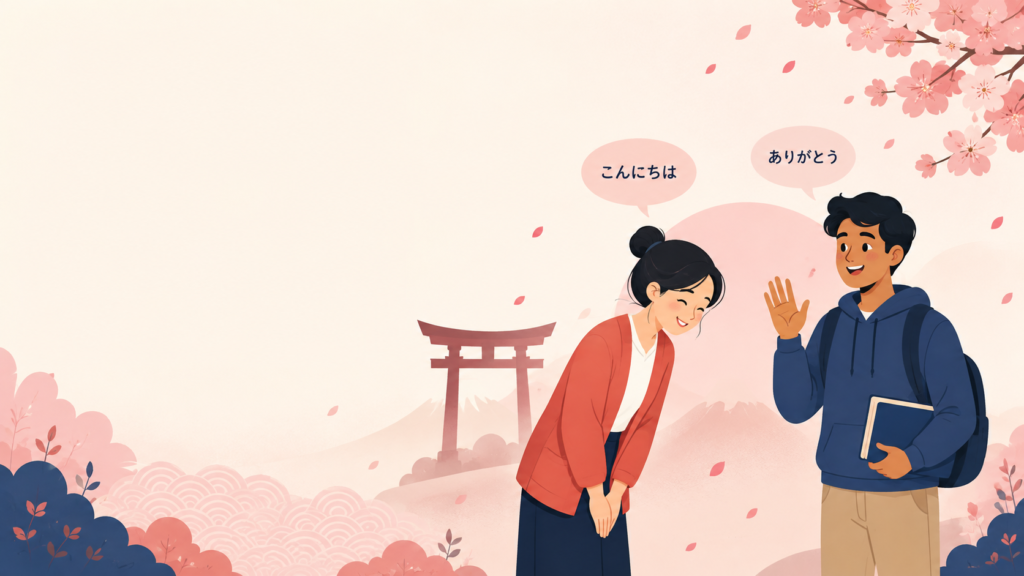
Japanese conversation runs on politeness markers. These small words carry a lot of social weight:
- ありがとうございます (Arigatou gozaimasu) — Thank you very much. Drop to “Arigatou” with close friends.
- すみません (Sumimasen) — A dual-purpose word meaning both “excuse me” and “sorry.” Use it to get a waiter’s attention or apologize for a minor inconvenience.
- お願いします (Onegaishimasu) — “Please,” used when requesting something or asking for a favor.
- どういたしまして (Douitashimashite) — “You’re welcome,” said in response to thanks.
- 大丈夫です (Daijoubu desu) — “It’s okay / no problem,” used to reassure someone after an apology.
- ごめんなさい (Gomen nasai) — A more sincere “I’m sorry,” used for bigger mistakes than Sumimasen covers.
- すごい (Sugoi) — “Amazing!” — a natural reaction word Japanese speakers use constantly.
- おめでとうございます (Omedetou gozaimasu) — “Congratulations.”
- がんばって (Ganbatte) — “Do your best” or “good luck,” said before someone attempts something.
Restaurant and Food Phrases
Japan’s food culture has its own mini-vocabulary that’s worth learning before your first trip or first izakaya visit:
- おいしい (Oishii) — Delicious.
- いただきます (Itadakimasu) — Said before eating, roughly “I gratefully receive this.”
- ごちそうさまでした (Gochisousama deshita) — Said after finishing a meal, thanking for the food.
- おすすめは何ですか (Osusume wa nan desu ka?) — “What do you recommend?” — useful when the menu is entirely in Japanese.
- 水をください (Mizu o kudasai) — “Water, please.”
Survival Phrases for Travelers

- 英語を話せますか (Eigo o hanasemasu ka?) — “Do you speak English?”
- どこですか (Doko desu ka?) — “Where is…?” — pair with a place name, e.g., “toire wa doko desu ka” (where is the toilet).
- いくらですか (Ikura desu ka?) — “How much is this?”
- わかりません (Wakarimasen) — “I don’t understand.”
- もう一度お願いします (Mou ichido onegaishimasu) — “One more time, please” — great for when someone speaks too fast.
A Sample Everyday Conversation
You: Konnichiwa! Friend: Konnichiwa! Genki desu ka? (Hello! How are you?) You: Genki desu! Oishii ramen o onegaishimasu! (I’m doing well! Delicious ramen, please!) Friend: Hai, douzo! (Here you go!) You: Itadakimasu! Arigatou gozaimasu!
Notice how naturally greetings, food phrases, and politeness markers combine in a single exchange — this is exactly the kind of fluency building block we focus on in the first month of our beginner course at Nihon Path.
The Cultural Layer: Why Politeness Is Built Into the Grammar
Unlike English, Japanese politeness isn’t just tone — it’s built into verb forms and word choice. This is similar to how Hindi distinguishes “tum” and “aap” depending on who you’re speaking to. In Japanese, this shows up as:
- Bowing Instead of shaking hands, people bow to greet one another, with the depth of the bow reflecting the level of respect being shown.
- Keigo (敬語), a formal speech register used with strangers, seniors, and in business settings
- Indirect phrasing to avoid sounding too blunt, especially when disagreeing or declining
Understanding this cultural logic early makes grammar concepts like keigo far less intimidating once you reach them in structured lessons.
Ready to Go Beyond Greetings?
Greetings are the doorway into Japanese, but real fluency comes from structured practice in grammar, listening, and speaking. At Nihon Path, our beginner-friendly Japanese courses are built for exactly this — starting from these everyday phrases and building toward JLPT N5 and beyond, with live instructors who correct your pronunciation from day one.
Call us on +91 93116 88893 or fill the form below today to start your Japanese learning journey.
Frequently Asked Questions
What is the most useful Japanese greeting for beginners?
Konnichiwa is the most versatile, since it works throughout the day in most everyday situations, both formal and informal.
Is Sumimasen the same as saying sorry?
Not exactly — Sumimasen covers “excuse me,” “sorry,” and even “thank you” in situations where someone has gone out of their way for you. Gomen nasai is used for more direct apologies.
Do I need to learn Hiragana before learning these phrases?
No — you can start speaking and recognizing these phrases in Romaji immediately. Hiragana becomes essential once you start reading and preparing for JLPT N5.
How long does it take to become comfortable with basic Japanese conversation?
With consistent practice — around 3 to 4 hours a week — most beginners can hold simple greetings-based conversations within 6 to 8 weeks.
Can I learn Japanese greetings on my own, or should I join a course?
Self-study works well for vocabulary and greetings, but pronunciation, listening comprehension, and correcting habits early are much faster with guided instruction — which is where a structured course helps.