

Learning Japanese from Scratch: What Should You Study First?
If you want to know how to learn Japanese from scratch, start with pronunciation and the Japanese writing systems, Hiragana and Katakana. Then build your vocabulary, learn simple grammar, practise speaking and listening, and slowly introduce Kanji into your studies.
Learning Japanese can feel confusing at first. You might open a book or watch a YouTube lesson and find unfamiliar characters everywhere. You may also wonder whether you should learn grammar first, memorize words, or start watching Japanese content.
The good news is that you do not need to learn everything in japanese at once. Following the right order makes Japanese easier to understand and helps you stay consistent.
In this blog, we will explain how to start learning Japanese, what to focus on first and how to build a simple study routine as a beginner.
1. Start With Japanese Pronunciation and Hiragana
Before learning long sentences, spend some time understanding how Japanese sounds. Japanese pronunciation follows fairly regular patterns, so beginners can start practising simple words early.
Next, learn Hiragana, one of the main Japanese writing systems. It is used for native Japanese words, grammatical endings and other parts of written Japanese.
For example:
- あ (a)
- い (i)
- う (u)
- え (e)
- お (o)
You do not need to memorize every character in one day. Learn a small group, practise reading it, and revise the characters you studied earlier.
Flashcards, handwriting practice and short reading exercises can help you remember them. Try to recognize each character without looking at its English sound.
After Hiragana, learn Katakana. This script is often used for foreign words, names and borrowed terms. For example, コーヒー (koohii) means coffee.
Learning these two scripts gives you a strong starting point for Japanese language learning for beginners. Avoid depending on English-letter spellings, known as romaji, for too long.
2. Learn Basic Japanese Words You Can Use Every Day
Once you begin learning Hiragana, start building your Japanese vocabulary for beginners. You do not need hundreds of words immediately. Focus on useful words that help you introduce yourself and talk about everyday things.
Start with categories such as:
- Greetings and introductions
- Numbers, dates and time
- Family and friends
- Food and drinks
- Places and transport
- Common verbs and adjectives
Here are a few beginner-friendly examples:
| Japanese | Pronunciation | Meaning |
|---|---|---|
| こんにちは | Konnichiwa | Hello |
| ありがとう | Arigatou | Thank you |
| 水 | Mizu | Water |
| 本 | Hon | Book |
| 食べる | Taberu | To eat |
Try to learn new words inside short sentences instead of memorizing translations alone. For example, learn how to use a word for water when asking for water or talking about what you drink.
Review old words regularly. Learning ten words and remembering them is more useful than memorizing fifty words and forgetting most of them the next day.
3. Understand Simple Japanese Grammar
Vocabulary helps you recognize words, but grammar teaches you how to put those words together. Learning basic Japanese grammar is an important step when you are trying to learn Japanese for beginners.
Start with simple sentence patterns. For example:
私は学生です。
Watashi wa gakusei desu.
Meaning: I am a student.
You can then learn how to make negative sentences, ask basic questions and talk about everyday activities.
Focus on these grammar topics first:
- Basic sentence structure
- は (wa), を (o) and に (ni) particles
- Simple questions
- Present and past tense
- Common verbs and adjectives
- Negative sentences
- Basic requests and descriptions
Do not try to memorize every grammar rule at once. Learn one pattern, understand how it works, and create a few sentences of your own.
Japanese sentence structure is different from English, so some sentences may feel unusual in the beginning. That is normal. Regular practice will help you understand the patterns.
4. Start Learning Kanji Gradually
Kanji is another important part of Japanese writing. These characters are used to represent meanings and appear throughout books, signs, messages and other written content.
Some beginners become worried when they hear that Japanese uses thousands of Kanji. However, you do not need to learn thousands of characters when you are just starting.
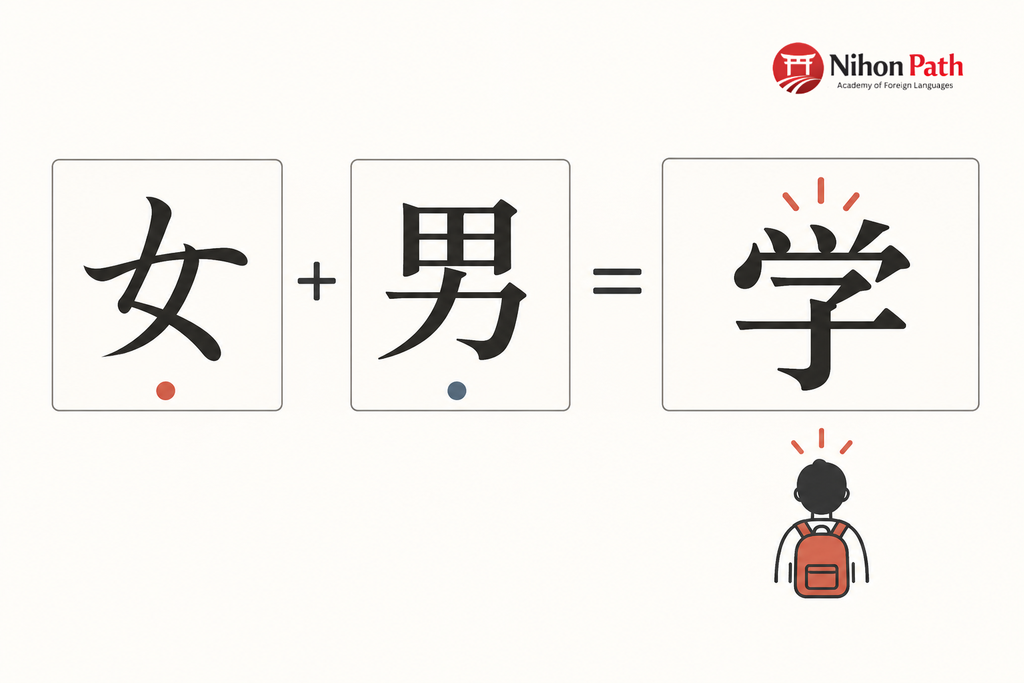
Begin with common characters that appear in basic words. For example:
- 日 — day or sun
- 人 — person
- 山 — mountain
- 水 — water
- 学 — study or learning
Try to learn Kanji through vocabulary rather than studying each character in isolation. For example, learning 学生 (gakusei), meaning student, helps you see how a character appears in an actual word.
You can start learning Kanji alongside vocabulary and grammar. There is no need to wait until you have mastered every other part of Japanese.
5. Practise Listening and Speaking From the Beginning
One common mistake is studying Japanese only through books. You might recognize words on a page but struggle to understand them when someone speaks.
To avoid this, include listening and speaking in your routine from the start.
You can practise by:
- Listening to short beginner Japanese dialogues
- Repeating simple phrases aloud
- Practising introductions
- Reading sentences aloud
- Listening to the same audio more than once
- Speaking with a teacher or language partner
Do not worry if you cannot understand every word. At first, focus on recognizing familiar sounds and expressions.
You can also use Japanese anime, songs or videos to make learning more enjoyable. However, entertainment should support your basic study routine rather than replace it. Some characters use informal or exaggerated expressions that may not be suitable for everyday conversations.
The goal is to understand simple Japanese and gradually become comfortable using it yourself.
6. Follow a Simple Japanese Study Plan for Beginners
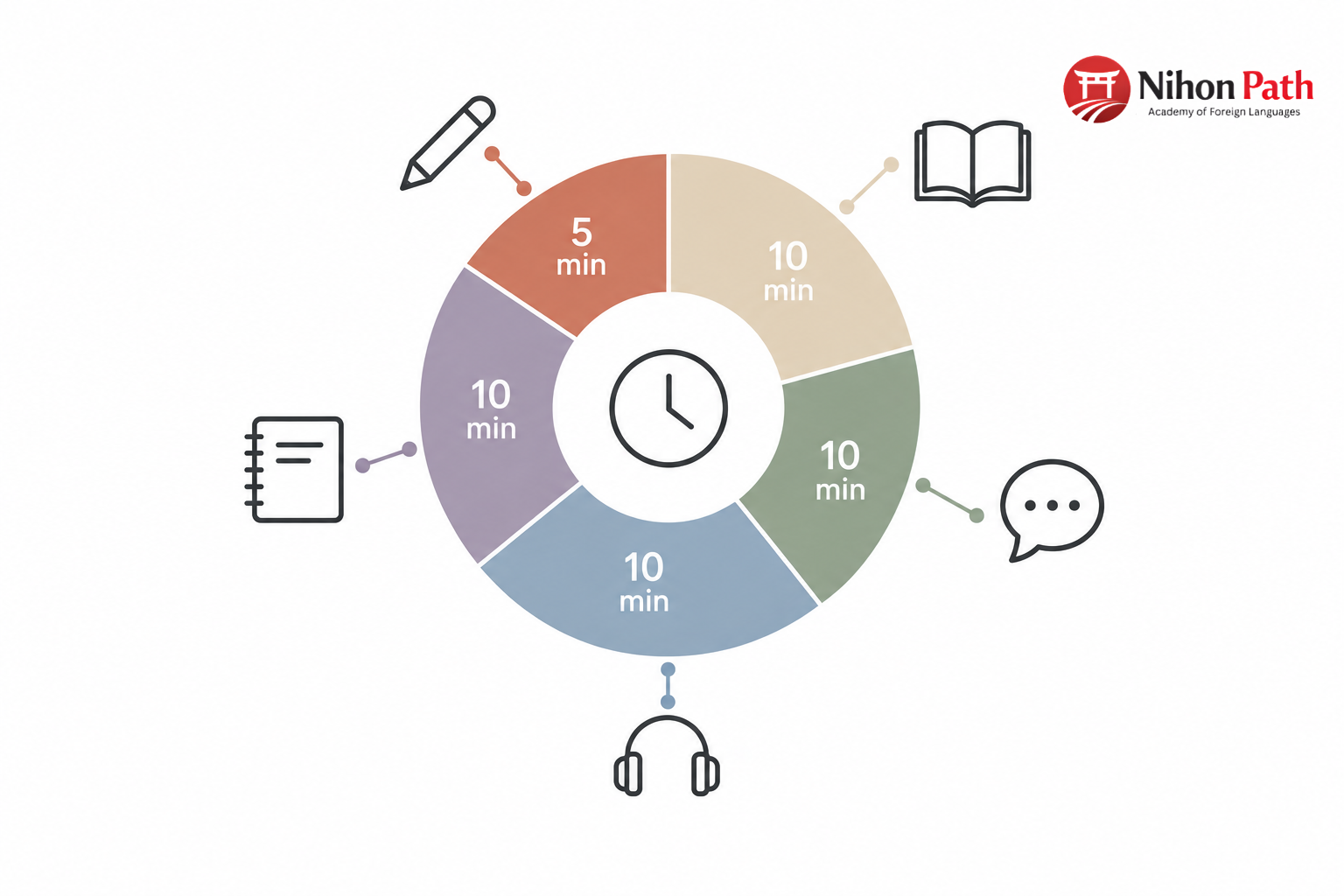
You do not need to study for several hours every day to make progress. A realistic Japanese study plan for beginners that you can follow regularly is a better starting point.
Here is an example of a 45-minute beginner study session:
| Study activity | Time |
|---|---|
| Revise Hiragana, Katakana or Kanji | 10 minutes |
| Learn new vocabulary | 10 minutes |
| Practise basic grammar | 10 minutes |
| Listen to Japanese audio | 10 minutes |
| Speak or write simple sentences | 5 minutes |
Adjust the routine according to your schedule. If you have more time, use it for reading practice or revising difficult topics.
Keep a notebook for new words, grammar examples and mistakes. Review it at the end of each week to see what you remember and what needs more practice.
Most importantly, avoid changing learning resources every few days. Choose a reliable textbook, course or learning plan and follow it consistently.
7. When Should You Start Preparing for JLPT N5?
The Japanese-Language Proficiency Test (JLPT) has five levels, from N5, the beginner level, to N1, the most advanced level.
If you are learning Japanese for an exam, JLPT N5 for beginners can be a useful first milestone. It focuses on basic vocabulary, grammar, reading and listening.
However, you do not need to register for the exam as soon as you start learning. First, build your foundation in the writing systems, vocabulary and basic sentence patterns.
When you are ready, read our JLPT N5 syllabus and preparation guide to understand what the beginner-level exam covers.
If you are unsure about the difference between N5 and the next level, our guide on JLPT N5 vs N4 can help you understand the progression.
How Can Nihon Path Help You Learn Japanese?
Starting on your own can work well, but it can be difficult to decide what to study next or whether you are practising correctly.
Nihon Path offers Japanese language courses for learners who want a more structured learning experience. Guided lessons can help you build your skills step by step, practise grammar and vocabulary, and work towards goals such as JLPT N5.
If you prefer learning with guidance instead of managing everything yourself, explore our online Japanese N5 course.
You can also visit the Nihon Path blog for more language-learning guides and practical tips.
Frequently Asked Questions
Can I learn Japanese from scratch at home?
Yes. You can begin at home using textbooks, flashcards, audio lessons and structured online resources. Regular practice and a clear learning plan are important.
Should I learn Hiragana or Katakana first?
Most beginners start with Hiragana because it is essential for reading many basic Japanese words and grammatical forms. After becoming comfortable with it, move on to Katakana.
Can I learn Japanese without learning Kanji?
You can begin learning basic Japanese without knowing much Kanji. However, Kanji becomes increasingly important as you progress, so it is best to introduce common characters gradually.
How much time should I study Japanese every day?
Start with 30–45 minutes a day if your schedule allows. Consistent practice is more useful than studying for many hours occasionally and then taking long breaks.
Is Japanese difficult for beginners?
Japanese may feel unfamiliar because its writing systems and sentence structure differ from English. Breaking learning into smaller steps and practising regularly can make it more manageable.